The College of Engineering has been recognized by the American Society for Engineering Education (ASEE) Diversity Recognition Program at the entry level (Bronze) for its effort in making measurable progress towards increasing diversity, inclusion and degree attainment.
The ASEE Diversity Recognition Program acknowledges colleges making progress within diversity categories. The program encourages improvement and accountability within the engineering higher education community.
Related Link
Engineering DEI Committee
“Receiving the ASEE Diversity Recognition is a great achievement for the college and (takes us) one step closer to … diversity and inclusion in engineering,” Maryam Raeeszadeh-Sarmazdeh, assistant professor and Engineering DEI Committee member, said. “Hearing diverse voices and including all from different backgrounds among the college in this conversation has a great importance.”
Engineering’s commitment to diversity, equity and inclusion also is reflected in its future plans.
“Next, our committee plans to work on the objectives outlined in the DEI action plan,” Gabrielle Bachand, Engineering DEI Committee chair, said. “Two of our top priorities are to build greater student-faculty-staff connection and to strengthen support for faculty and staff.”
“We look forward to achieving the next ASEE Diversity Recognition Program level (Silver) in the future, and this will require sustained progress towards our DEI goals,” Bachand added.
The ASEE recognition is the second DEI-related affirmation the College has earned over the past year.
“In 2023, we also gained admission to the GEM Fellowship program,” Bachand said, “so we are working on promoting opportunities and engagement with this valuable resource.”
The GEM Fellowship focuses on promoting opportunities for graduate students to enter high-level tech industry jobs.
The College’s DEI Committee continues to grow and improve through its activities and support for affinity groups such as the University chapters of the Society of Women Engineers, National Society of Black Engineers and the Society of Hispanic Professional Engineers.
This Earth Month, departments across the University are collaborating to host a multi-day celebration focused on sustainability.
At the Earth Day Fest on Monday, April 22, participants will be asked to take the pledge and share their individual actions this month to help make “Silver and Blue the New Green,” a key tenant of the University’s strategic plan that seeks to establish the Reno-Tahoe region as an epicenter of sustainability, research and leadership. Participants will be asked to write down what they are committed to doing in the month of April and will receive a pledge pin or sticker.
“Earth Month gives us the opportunity to celebrate our natural world,” said Phoebe Judge, sustainability manager for the University. “Big or small, individual actions can make a difference and we’re asking the Wolf Pack to pledge one Earth-friendly action. This can be as simple as riding your bike, using less water, or turning off the lights.”
Sustainable Nevada, Joe Crowley Student Union, Graduate Student Association, Nevada Dining, Riverside Farmers Market and others have joined together to create a vibrant and educational experience exclusively for the Wolf Pack community.
Events will include:
Nevada Dining ThoughtFul Week- April 8 to April 12. This special time is dedicated to promoting and honoring the importance of self-care, mindfulness, spreading positivity and coming together. View all of the events on the Nevada Dining blog. Students and staff are also participating in a food waste competition.
Eco-wise Wolf Pack on Thursday, April 11, from 2 to 4 p.m. in the Argenta Hall Mezzanine. Participants will learn about sustainable resources surrounding the campus and grab sustainable supplies and samples. Hosted by Residential Life, Housing and Food Services.
Nevada Geothermal Town Hall on Tuesday, April 16, from 6 to 9 p.m. at the Davidson Math and Science Center, Room 110. A panel of experts will share their knowledge and expertise on geothermal energy in Nevada. Attendees can expect to learn about the basics of geothermal energy, the state’s role in harnessing geothermal power and the impact on local communities and how the University contributes to the advancement of this technology. Registration for this event is open via Eventbrite.
University of Nevada, Reno night at Reno Bike Project, Tuesday, April 16, at 5:30 p.m. at 635 East Fourth Street, Reno. This is an opportunity for students to fix up their mountain bike, commuter bike, unicylce and more with the help of Reno Bike Project experts. Sign up to bring your bike in this event that is reserved for the University community.
Climate Café, Wednesday, April 17, from 5:30 to 7 p.m. at the Great Basin Hall Multipurpose Room. Hosted by Counseling Services, this is an informal open, respectful, confidential space to safely share emotional responses and reactions related to the climate and environmental emergency.
Earth Day weekend at Lake Tahoe, Friday April 19, to Saturday, April 20 at the University of Nevada, Reno at Lake Tahoe. Students are invited to explore the Lake Tahoe location and greater Lake Tahoe area as well as connect with amazing campus faculty and spend a night in the campus residence halls. Participants must register in advance via Formstack.
Nevada Athletics Softball Game on Sunday, April 21, at noon at the Christina M. Hixon Softball Park. Join Nevada Softball in celebration of Earth Day as they take on Boise State. Purchase tickets.
Day of Service on Monday, April 22, from 8 a.m. to 3 p.m. hosted by the Graduate Student Association (GSA) and Facility Services. Join GSA in planting flowers in the 15th Street roundabout. Volunteers will be asked to take one-to-two-hour shifts to be in the sunshine and plant flowers that will beautify campus. Volunteers must register for the GSA Day of Service.
Earth Day Fest, Planet vs. Plastic, Monday, April 22, from noon to 3 p.m. at the Joe Crowley Student Union (JCSU) Gateway Plaza. The event will include a Farmers Market hosted by Riverside Farmers Market with locally sourced goods, produce and services. Additional booths will include coaster painting, free plants and the chance to win a free bike. Participants also will be asked to take the Earth Day pledge.
Sierra Community Garden Initiative on Monday, April 22, from 4:30 to 6:30 p.m. at the Sierra Hall Garden Patio. Join the Sierra Hall Leadership Council to learn gardening skills and bring new life to an outdoor campus community space by planning and cultivating foliage and flowers. Supplies and materials will be provided by University Grounds Services.
JCSU Thrift Swap on Wednesday, April 24, from noon to 3 p.m. at JCSU Gateway Plaza. Join the Joe for this Thrift Swap event in honor of Earth Day, where sustainability meets style. Bring along gently-used clothing to participate in this swap event.
Pedal with the Pack on Friday, April 26, from 3:15 to 6 p.m. starting at the JCSU Gateway Plaza. This event brings new and experienced Wolf Pack bike riders together for a fun social ride from the University’s main campus to Mayberry Landing and back. The University Bicycle Working Group will lead the ride at a relaxed pace and can assist with maintenance issues along the way. Participants must RSVP for Pedal with the Pack for Earth Month and are required to bring their own bike and helmet.
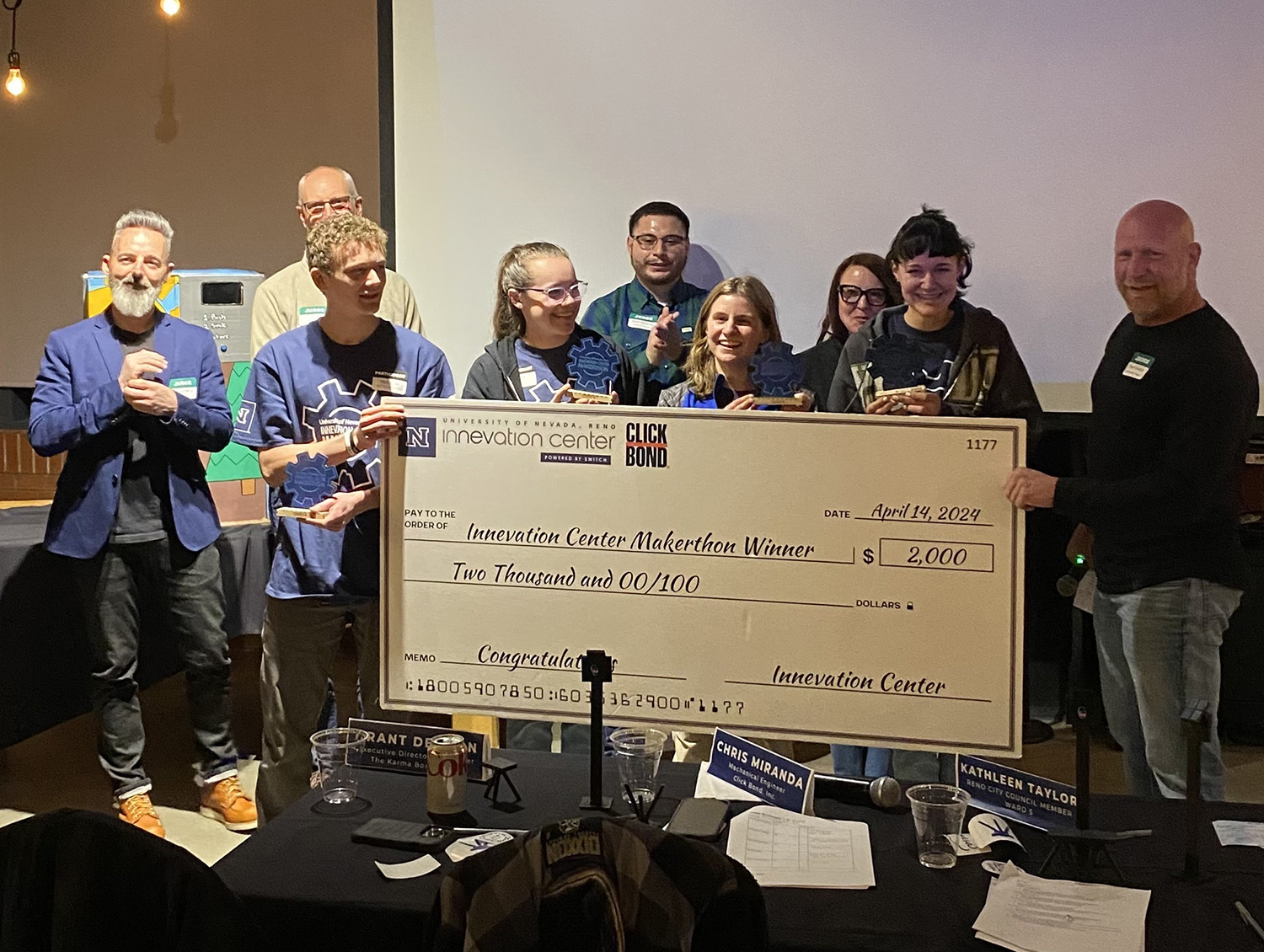
The University of Nevada, Reno Innevation Center held its fourth annual Makerthon competition, presented in collaboration with Click Bond, Inc., April 12-14, 2024. This year, 30 students on seven teams were featured in the 48-hour competition.
“The Makerthon is a great opportunity for students to explore ideas, even create some solutions that are good for the community,” Juston Berg, vice president of Entrepreneurial Development for the Economic Development of Western Nevada (EDAWN) and one of this year’s judges, said.
Related Programs
2024 Makerthon
University of Nevada, Reno Innevation Center
Using the Makerspace’s wide array of tools, machinery and software, teams of students from both college and high school had 48 hours to develop, test, produce and then present a prototype of their product to a panel of judges. This year’s judges included Berg, Christopher Miranda-Ruiz with Click Bond, Kathleen Taylor, Ward 5 City of Reno councilwoman, Tom White, chairman of the Board at HAWS Corporation, and Grant Denton with the Karma Box Project.
“Makerthon is all about creating curiosity for the future generations,” Miranda-Ruiz said.
The teams comprised of high school, graduate and undergraduate students from Reno High School, Reed High School, Truckee Meadows Community College, the University’s Upward Bound Program and De La Mare Library. Some students were even competitors from previous years returning to vie for Makerthon champions.
The competition’s real-world challenge prompt stated:
“Homelessness is a multifaceted challenge in our community, encompassing more than just a lack of shelter. Individuals grappling with homelessness face obstacles such as limited access to essential resources, societal stigma, and the ongoing pursuit of stability. In this context, Makerthon 2024 invites you to engage your inventive spirit to directly address the specific challenges faced by those experiencing homelessness in Reno.
“Think beyond immediate relief – envision a product that enhances these individuals’ quality of life, fosters inclusion, and provides sustainable solutions to the unique obstacles they may encounter. Let’s channel our creativity into making a genuine and positive difference. Whether it’s improving living conditions, facilitating community connections, enhancing resource accessibility, health and hygiene, and much more, your product should be a practical and tangible solution that addresses a real need.
“Your mission is simple: create a tangible product that makes a significant impact on the lives of individuals facing homelessness.”
“I think this is important because it’s young kids coming up with innovating ideas to solve real problems,” Denton said.
The winning members on Mathemusicians are Nick Cotè, Alex Vankirk, Rhys Vankirk and Indigo Walenta. They took home a $2,000 check prize for their invention, a prototype product called c-kube, a secure storage locker designed to support unsheltered individuals in their difficult journey toward societal reintegration, specifically getting to appointments.
Related Links
2024 Makerthon – sponsored by Click Bond, Inc.
KTVN, Chn. 2 Segment: Students compete in ‘Makerthon’
KOLO 8 News Segment: Makerthon Competition
“We made this specifically for people who are experiencing homelessness and are often put in a scenario where they have to carry their entire livelihoods on their back,” Cotè said.
The storage container prototype features an unlocking system using facial recognition, a touch-free and sanitary access option with no codes to remember, helping prevent illegal activity. The team suggested that the lockers could be painted by local artists and sponsored by local businesses, including Eddy House, Northern Nevada Continuum of Care, Katie Grace Foundation, Society of St. Vincent de Paul, the VA Sierra Nevada Health Care System and Renown Health.
Winning team Mathemusicians were awarded $2,000 for their prototype product called c-kube.
Second place, with an award amount of $1,000, went to team Water Benders with their product Community Connect: a geofenced, solar powered, antitheft kiosk with a user interface point-source providing directions and access to resources. Third place, and a prize of $500, was awarded to Fred’s Fabricators with C.U.B.S: a cleansing utility boxes & storage for a discreet solution to hygiene for homeless or struggling youth.
The College of Education & Human Development held its annual Spring Celebration awards ceremony on April 16, 2024. More than 125 people gathered for the event at the Atlantis Casino Resort Spa Paradise Ballroom.
The celebration honored the outstanding accomplishments of the College’s students, faculty and staff. It also recognized the generous donors who support the students and the impactful work within the College.
President Brian Sandoval opened the evening by describing the College’s historical significance and remarking that it is close to his heart, as both his mother and daughter are graduates of the College. He also congratulated the award-winners and spoke about their commitment to excellence and outstanding work in advancing education in Nevada.
Donald Easton-Brooks, Ph.D., dean of the College of Education and Human Development, thanked the donors for generously supporting the students through scholarships, the faculty for producing cutting-edge research, and the students for their incredible perseverance and hard work.
“The Spring Celebration honored the achievements of faculty and students and recognized our donors for their wonderful support,” Easton-Brooks said. “It also celebrated the profound impact these individuals have on our community and reaffirmed the College’s commitment to life-changing learning.”
Quentin Smith, M.Ed., director of development, was the master of ceremonies. He also held a silent auction featuring playful artwork creations from the children in the Child and Family Research Center.
Smith emphasized the importance of collaboration and working together to achieve any endeavor that a group can accomplish expeditiously. He exclaimed, “Why walk through life when you can run with the Pack?”
Keynote speaker Kristen Remington, 2 News Anchor, gave an inspirational message about an educator who made a difference in her life. By believing in her and having high expectations, her teacher helped shaped her from being a shy student to now a news anchor. She remarked that our faculty and students make such a positive impact through their mentorship.
The highlight of the evening was Associate Dean Eleni Oikonomidoy, Ph. D., honoring the Nevada Center for Excellence in Disabilities with the Excellence and Innovation Award in Diversity, Equity and Inclusion.
“It was wonderful to celebrate the numerous accomplishments of the College’s students, faculty and staff,” Oikonomidoy said. “We would like to thank President Sandoval and our keynote speaker Kristen Remington for their powerful words and Quentin Smith for a wonderful job hosting the event. A special thanks also goes to our donors for believing in our mission and contributing to the College’s success.”
Student awards included:
Eneida Castaneda-Sanchez: Dana Davis Award
The Dana Davis Award recognizes graduate students specializing in secondary education who exemplify the qualities of devotion to high academic standards, personal integrity and love for students. The award is in honor of Professor Dana Davis, who was a distinguished College of Education faculty member for 26 years.
Nicole Murphy: Mary Demchak Memorial Award for Doctoral Student Research in Intellectual Disabilities
The Mary Demchak Memorial Award for Doctoral Student Research in Intellectual Disabilities was established in honor of Mary Demchak by her daughter, MaryAnn Demchak, Professor of Special Education. Mary enjoyed spending time with her daughter’s special education doctoral students. It brought her joy to listen to them discuss their research areas. She was inquisitive about each student’s progress and was known to motivate them by asking, “What’s next?” in hopes of getting them to expand their research. Through this award, Mary will be remembered for inspiring doctoral students to move their research forward.
Jake Yoxsimer: The Marshall R. Matley Distinguished Scholar in Special Education
This award recognizes individuals working toward a Master’s Degree in Special Education and Disabilities Studies.
Joel Peixoto: Edwin S. Dodson Educational Leadership Award
This award recognizes students who are principals, administrators or others working toward administration preparation.
Miranda Lopez: Dr. George Hill & Dr. Ginny Knowles Leadership Award
This award recognizes a graduate student pursuing a master’s degree in educational leadership.
As a first-generation Filipina college student, Lauren Parker has suffered from her fair share of imposter syndrome and self-doubt but chooses to use each new experience as a learning opportunity, rather than a roadblock. Her lifelong passion for learning and a desire to share knowledge led her to pursue a Ph.D. in cellular molecular pharmacology and physiology at the University of Nevada, Reno School of Medicine (UNR Med).
Currently a first-year Ph.D. student, Parker is examining how a small drug molecule affects prostate cancer metastasis. Depending on the results of this project, she intends to continue to study the effects of this drug on cervical cancer and other reproductive diseases.
As she narrows her research focus, Parker hopes to study female reproductive diseases that affect fertility as well as how to make assisted reproductive techniques less invasive and less troublesome for women.
After completing her Ph.D., Parker is interested in exploring industry research or clinical research and ultimately sees herself returning to academia to pursue teaching and a research lab.
“I decided to pursue research because I love learning and challenging myself. From a young age, I knew that I wanted a career that involved teaching in some capacity. It wasn’t until I started college that I learned you could have a career dedicated to researching a specific area of science. When I came to the realization that I could teach and conduct research related to reproductive biology, I knew that a Ph.D. was what I needed to do so that I could one day become an academic. It is very motivating to know that I can share my knowledge in the form of teaching and in the form of contributing to the greater knowledge within scientific research.”
What is the biggest challenge you have faced in your UNR Med education and how did you overcome it?
“Being a first-generation college student and entering my Ph.D. program without a master’s has resulted in some serious imposter syndrome. It is difficult not to feel inferior when you are surrounded by classmates who have more knowledge and research experience than you. My first semester was challenging in the way that I was afraid to ask questions when it felt like I should already know the answers. I’ve come to realize that many of my classmates feel the same way as I do, we all are just really good at hiding it – and that is extremely validating.
“Additionally, all of my instructors have been very kind and even happy that I ask for help and/or clarification, which has been so relieving. Ultimately, I came to the realization that I needed to make the most of my graduate education. I acknowledge that I have so much to learn and I try my best to reframe my self-doubt by instead embracing the fact that I have an amazing opportunity to learn from my experienced peers and from the well-respected experts in my program.”
What specialty or area are you most passionate about pursuing, and what draws you to this field?
“I am incredibly passionate about reproductive biology. Specifically, I am interested in studying female reproductive diseases that affect fertility and how to make assisted reproductive techniques less invasive and less troublesome for women. It sounds cheesy and simple, but what drew me to this field is the fascinating way that life is formed. It is mind-blowing to me that you can take a male and a female gamete, cells that we can’t even see with the naked eye, and when you bring them together, they hold the instructions for creating a human being.”
Can you share a memorable experience during your training that has significantly impacted your journey?
“As I was getting to know everyone in my first lab rotation, I was talking with our Research Associate Professor about my past research experiences and how I felt I was not allowed to make any mistakes. He told me ‘You’re going to make some mistakes, that’s inevitable, but you learn your best when you make mistakes and fail,’ and that was so reassuring to hear.”
What advice do you have for future students interested in pursuing research?
“Always be kind and try your best to attend/participate in your program’s events – even if you think it’s not related to your research/goals or if you think it might be boring. It’s really important to show your face and to be a somewhat active member of your program. Being kind and showing up can bring you more opportunities than you might think.”
Jorge Esparza is an Honors student at the University of Nevada, Reno. He is dedicated to researching human-wildlife conflicts. He was the treasurer for the University’s Wildlife Society and is a Biology learning assistant through the University’s Biology Peer Instruction Program. He enjoys playing video games, watching hockey and hiking when he has the time.
Esparza wishes to pursue a master’s degree or enroll in a graduate program where he can continue to research human-wildlife conflicts. His current research focus is on human-elephant conflicts, and he hopes to go to India someday to study human-tiger conflicts.
“It feels great to be a part of a larger community of scholars who are just as motivated, and dedicated, to overachieve in their academic or co-curricular endeavors,” Esparza said when asked about his experience at the Honors College. “I feel like I belong and all of us are here to obtain the maximum success in some way, shape or form. It’s amazing.”
Through the Honors College, Esparza was able to learn about many different fellowships and grants he could apply to. So far, he has applied to the Payne Fellowship, the FAS International Agriculture Fellowship, the PD Soros Fellowship for New Americans, and the NSF GRFP Fellowship. He was also an NSF EPSCoR grant recipient last spring (2023).
Esparza applied to these fellowships in order to fund his research and help him travel internationally. He’s most excited about the Payne fellowship and FAS fellowship. If he is awarded either of these fellowships he will be able to travel and do the kind of work he’s interested in. For either of those fellowships, he will get to participate in two internships that will be beneficial for his academic career.
Esparza participated in the International Research Opportunity: Sri Lanka program during the summer of 2023. This program is funded by the National Science Foundation (NSF) IRES grant. It covers the cost of any project-related travel, lodgings and meals in Sri Lanka. Through the program, students travel to Sri Lanka to conduct research in Wasgamuwa National Park. Any full-time undergraduate student at the University of Nevada, Reno may apply. The program is eight weeks long during the summer. The students work with field biologists, conservationists and extensionists throughout their trip and focus on understanding the causes of human-elephant conflicts. They also work with a mentor who guides them through their research projects.
Esparza loved getting to try the food in Sri Lanka, learning more about the culture, and interacting with the locals. He enjoyed working with the local communities so much during his trip that he hopes to continue to pursue his research internationally in the future.
“One of my favorite parts of going to live out in the countryside in Sri Lanka was sometimes during interviews or human-elephant conflict surveys of locals, we would serve as teams,” Esparza said. “Sometimes it’s those small things that really make a big difference collectively.”
Overall, he had an amazing time and was very happy he was able to experience traveling to another country.
“I highly recommend this opportunity to other students regardless of their major,” Esparza said.
He mentioned how this program can allow any student to study the different factors that go into the human-elephant conflict. One could study the economics of the issue, the politics or even the effects these conflicts have on the environment.
Project Orange Elephant inspired Esparza’s research in Sri Lanka. Project Orange Elephant showed farmers if they planted orange trees around their crops, elephants were more likely to avoid the area. This study made Esparza curious about what other plants farmers could grow to help protect the farmers’ crops from elephants. He learned the plants in more closed areas were avoided by the elephants. They seemed to like the plants that could be found in the more open areas.
Lost your keys? Misplaced your glasses? Can’t remember where you parked the car? You may wish you had the memory of a mountain chickadee.
In warmer months, these half-ounce birds, with brains slightly larger than a pea, stash tens of thousands of food items like seeds in tree bark, in lichens and crevices on the tree branches across the mountains. When winter arrives, they can recall the exact locations of their caches, a skill that helps them survive the bitter cold and deep snow.
In a new study published on April 17 in the journal Current Biology, researchers at the University of Nevada, Reno and CU Boulder identify nearly a hundred genes associated with the birds’ spatial memory, or ability to recall the locations of objects. The paper also suggests a potential trade-off may exist between having a solid long-term memory and being able to quickly ditch old memories to form new ones.
The findings could help biologists better understand the evolution of spatial memory in animals, including humans.
Vladimir Pravosudov is a professor of biology, and has studied the chickadees in the Sierra Nevada for 25 years.
“Using a field system of testing spatial learning in memory in wild birds we’ve been using for many years, we teamed up with collaborators to parse out which genes might influence how well a chickadee can learn and remember spatial locations,” Pravosudov said.
To evaluate the spatial memory of wild mountain chickadees, Pravosudov’s team designed a clever test. They hung multiple feeder arrays, each with eight bird feeders with seeds in the Sierra Nevada mountains. Each feeder has a gate with a radio frequency reader that can detect a tag researchers put on chickadees. The team then programmed each of the eight gates to only open to certain birds, so that the chickadees had to remember the location of the correct feeders that would open to them.
Pravosudov and his team then measured the birds’ spatial memory by counting how many times each chickadee landed on the wrong feeders before they recalled the right one – birds with better spatial memory have a lower error rate.
Related Links
Feeding mountain chickadees at Chickadee Ridge is okay, new research says
Chickadees are canaries in the coal mine for climate change
Using blood samples, the team at CU Boulder also sequenced the entire genomes of 162 tagged chickadees that have been tested for their spatial learning and memory ability using the smart feeder arrays, creating the largest dataset ever collected for evaluating the genetic basis of chickadee cognitive ability. By comparing the birds’ genomes with their performance on the feeder test, the team identified 97 genes associated with chickadees’ spatial learning and memory. Birds with specific genetic variants at these genes made fewer wrong attempts before landing on their designated feeders compared to those without them.
A large proportion of these genetic variants are associated with neuron formation in the hippocampus, a part of the brain that’s responsible for learning and memory, according to Sara Padula, a co-author on the paper and a Ph.D. student in the Department of Ecology and Evolutionary Biology at CU Boulder.
“Understanding the genetic basis of this trait will allow us to understand how the trait evolves,” Scott Taylor, the director of CU Boulder’s Mountain Research Station and associate professor in the Department of Ecology and Evolutionary Biology, said.
According to Taylor, the common ancestor of all North American chickadees cached food. But of the seven species of chickadees now found in North America, two do not cache food.
“They live in a milder environment where food is generally available year-round. Now that we know the gene regions that underlie spatial memory, we can look at what variation looks like in these species that have lost caching,” Taylor said.
“This study substantially advanced our understanding of the genetics of spatial memory in birds and behavioral genetics more broadly,” said Georgy Semenov, the paper’s co-author and a research associate in the Department of Ecology and Evolutionary Biology.
Chickadees that have exceptional spatial memory can live up to eight or nine years, which is a long time for a small bird, Taylor said. But having good long-term memory may come at a price.
After running the initial task for a few days, Pravosudov’s research team assigned new feeders to the birds to test how well birds can learn new locations after they have been consistently rewarded at a different feeder, a test usually used to assess cognitive flexibility.
Interestingly, chickadees from harsher higher elevations seemed to always perform worse on this ‘reversal’ test despite having better spatial learning and memory abilities compared to birds from lower and milder elevations. They seemed to have a harder time abandoning their initial memories and creating new ones.
“In a more variable environment, what our collaborators found suggests that chickadees with good long-term memory may have a disadvantage,” Padula said.
A shifting climate
Like many other habitats, mountains experience rapid changes in climate characterized by more rapid shifts between extreme drought and extreme snowfall and it is not clear how birds can adapt to such changes and how such changes may affect memory ability.
“Because of climate change, we might expect these selective pressures that have been shaping chickadee’s special memory for thousands of years to shift significantly. Understanding the genetic basis of the trait will allow us to track changes in their genomes over time,” Taylor said.
“Tracking genetic changes associated with spatial cognition will allow us to better understand the evolutionary process associated with climate change,” Pravosudov said.
The University of Arizona earned recognition across several categories in the 2024 U.S. News & World Report Best Colleges ranking, released Monday.
The university’s undergraduate program for management information systems, housed within the Eller College of Management, rose two spots to No. 3 overall and No. 2 among public universities. On the publication’s annual Best Graduate Schools list, released April 25, U.S. News ranked the MIS master’s program No. 1 among public universities and No. 3 overall.
In U.S. News & World Report’s Best National Universities ranking, UArizona is tied for No. 115 overall and tied for No. 58 among public universities. The university is No. 14 among all colleges and universities that are designated as Hispanic-Serving Institutions and No. 25 among state flagship universities. UArizona’s overall score of 62 is a two-point increase from last year and is the university’s best score in the history of the rankings.
“I am proud to see that U.S. News & World Report has ranked the University of Arizona as one of the nation’s strongest public universities,” said University of Arizona President Robert C. Robbins. “Our institution serves a growing and diverse student population that has the opportunity to learn from many of the world’s top research scholars across a wide spectrum of subjects.”
U.S. News & World Report’s methodology added new categories and statistics to rank universities based on research impact and productivity: citations per publication, field-weighted citation impact, publications cited in the top 25% of journals, and publications cited in the top 5% of journals. UArizona ranked in the top 100 overall in each of the four categories and ranked in the top 40 among all public universities in three of the categories.
Citations per publication: 72 overall, 40 public
Field-weighted citation impact: 74 overall, 39 public
Publications cited in top 25% of journals: 60 overall, 37 public
Publications cited in top 5% of journals: 84 overall, 53 public
Each year, U.S. News also releases a Best Value ranking, which considers a school’s academic quality, as indicated by its 2024 ranking, and the 2022-23 net cost of attendance for a student who received the average level of need-based financial aid. The university placed No. 119 on this list – up 24 spots from the previous year.
In The New York Times’ most recent edition of the College-Access Index, which measures economic diversity by analyzing the share of students receiving Pell Grants, UArizona tied for No. 30 among public universities and tied for No. 13 among state flagship institutions.
Other U.S. News & World Report undergraduate rankings include:
Entrepreneurship: No. 17
Business: No. 29
Marketing: No. 40
Accounting: No. 46
Computer science: No. 50
Engineering: No. 50
Psychology: No. 51
Economics: No. 58
Nursing: No. 67
Best Colleges for Veterans: No. 76
Other recent rankings include:
UArizona was ranked No. 96 overall and No. 64 among public universities in the Washington Monthly’s 2023 National University Rankings, released Aug. 27. This ranking analyzes colleges and universities based on their contribution to the public good in three categories: social mobility, research and promoting public service.
UArizona ranked No. 114 overall (up 17 spots from last year) and No. 52 among public universities in Forbes’ annual list of America’s Top Colleges, released Aug. 29.
U.S. News & World Report ranks colleges and universities based on several measures of academic quality. The measures considered for national universities include graduation and retention rates, assessment by peers and counselors, faculty resources (such as class size, benefits and salaries), student selectivity, financial resources for students, alumni giving, and graduation rate performance, which is the difference between actual and predicted graduation rates.
Note: Not all academic programs are ranked annually by U.S. News & World Report. The above rankings are newly released. U.S. News & World Report also releases rankings of the best online programs, best global universities and top graduate programs. For questions regarding the rankings of specific
Groups of gardening enthusiasts were huddled around lab tables examining preserved insect specimens, learning the tell-tales signs of invasive pests that a warming climate could bring to the Pacific Northwest.
It was a cloudy afternoon at Washington State University’s Extension offices in Spokane County and with spring just around the corner the nearly 50 participants were taking careful notes. Similar educational exercises on a range of topics are conducted at Extension sites across Washington as part of a broader effort to promote climate change mitigation and adaption. This piece of that effort aims to improve early detection of invasive pests and diseases that can damage not just yards and gardens but entire crops and ecosystems.
“We’re training participants in our Master Gardeners program to be early detectors,” said Tim Kohlhauff, an urban horticulturalist with Extension in Spokane, who worked his way from table to table helping instructors answer questions. “Our volunteers tend to spend a lot of time in their yards and gardens, and by sharing what we know about the early warning signs, they’re helping expand the layers of protection for our state and region.”
Of the roughly 70 invasive pests detected in Washington since 1990, a study found more than a third of the first reports were from private individuals rather than government agencies and regulators. Many of those were master gardeners, said Todd Murray, an Extension entomologist and director of WSU’s Puyallup Research Center, who spearheaded the study.
That kind of early detection is key to containing potentially devastating infestations, said Murray, who also serves on the state’s Invasive Species Council. “One of the reasons I wanted to work at WSU is because of the Master Gardeners program,” he said. “It’s a great volunteer model that brings so much value to our state.”
It’s also just one example of how WSU Extension is moving greater climate awareness into its award-winning programming.
“Extension is about helping build resilient communities,” said WSU Extension Director Vicki McCracken. “We’ve been doing that as a partner in the growth of this state for more than a century through direct community outreach and as the needs of our communities change and evolve so can our programming.”
Indeed, adaption and mitigation have always been key to Extension’s mission, whether it’s helping farmers identify the best varieties for current local conditions or taking applied science directly to the families and others who can use it to address pressing needs.
“WSU has so much expertise that could benefit how the Pacific Northwest positions itself to deal constructively with these challenges,” said Brad Gaolach, director of the university’s Metropolitan Center for Applied Research and Extension. “We are working to make sure it’s being shared with those who can use it.”
Clark County Extension, for example, is working with community partners to pioneer an effort to reduce food waste. The multifaceted project includes helping families improve meal planning and learn how to best preserve food as well as supporting local farmers and increasing healthy food access for communities.
“There are things we can do right now that can begin to help us mitigate and adapt to these impacts,” said Kristine Perry, interim director of Extension operations in Clark County.
In Snohomish County, efforts are underway to build Extension’s volunteer base through projects such as its Sustainable Community Stewards program, which serves both English- and Spanish-speaking participants. The volunteers receive sustainability training and help promote recycling and food waste reduction. They also participate in a repair cafe where broken items can be fixed and reused instead of thrown out.
“This is about finding ways to bring climate to the forefront of our work,” said Anthony Gromko, director of Extension operations in Snohomish County.
For many, this kind of outreach can be a first exposure to the resources WSU has available to communities.
Water was the star of the show in Washington State University’s pavilion at Expo ’74 in Spokane.
Expo ’74 organizers approached WSU to create an exhibit highlighting the importance of water. After all, the event would be the first environment-themed World’s Fair. Its location straddled the Spokane River. And WSU’s Albrook Hydraulics Laboratory was renowned for its water research.
“The opportunities for worldwide exposure of our students and university are almost beyond comprehension,” then-WSU President Glenn Terrell said in a February 1974 memo to WSU administrators announcing the university’s participation in the World’s Fair.
In a few short months, WSU created Waterworld, a pavilion sandwiched between the United States and USSR pavilions, both big draws at the fair. Among Waterworld’s exhibits were a dazzling “waterbell” fountain and a room-sized scale model showing the life cycle of water.
WSU students also participated. About two dozen were hired to serve as pavilion hosts for the duration of the fair. Clad in red-and-blue polyester jumpsuits, they answered questions, gave scripted explanations of the exhibits, and even did some maintenance, recalls John Ahlers, a civil engineering student who was one of the hosts.
The fountain was “a beautiful water sculpture,” he said. “Then people started putting coins in our fountain. The algae would grow in there and we’d have to roll up our pant legs and clean the jets out.”
Albrook lab director John Orsborn and civil engineering faculty member Manuel Arce led the work on the pavilion’s exhibits. The watershed model, which demonstrated the demands on streams as they flow through coastal, arid, and temperate regions, was built at the lab.
“We were having a heck of a time carving the mountains,” Ahlers said. “Someone had a connection with the architecture program, and I remember one Saturday we had about 20 architecture students over there helping us carve this beautiful mountain.”
Waterworld also featured a synchronized slideshow with taped narration, a scale that showed visitors how much of their body weight was water, and a small display on WSU. Upstairs was a VIP lounge for customers and business associates of Rainier National Bank in Seattle, which donated money for the pavilion.
An estimated 1.5 million to 1.6 million people visited Waterworld during the World’s Fair.
WSU’s ties to Expo ’74 included co-sponsoring a symposium that September titled “The Environment and the Economy — Exploring the Tradeoffs.” Speakers included officials from the Environmental Protection Agency, the Sierra Club, and the Bonneville Power Administration.
The university also sent one of its public relations staff, Al Ruddy, to Spokane to help Expo ’74 with publicity. Ruddy recalls that he got to meet celebrity Danny Kaye on Expo’s opening day.
Gary Southern, a WSU pharmacy student and Waterworld host, still has his polyester jumpsuit and other mementos of the experience. He and other student hosts would carpool to Spokane from Pullman for their Expo ’74 shifts until summer break started. Then some stayed with friends and family while others rented shared housing.
“We had free passes to get into Expo because we were hosts,” Southern said. “I remember meeting people from all over the world.”
Leslie Nellermoe, an environmental science student, said she saw her first concert — John Denver — at Expo ’74.
Psychology major Robin Lee Gillis said the camaraderie of the WSU student hosts is what she remembers most fondly.

 Oregonstate News Blog